Kwusen is proud to support the Brandon Residential School Missing Children Investigation, led by Sioux Valley Dakota Nation. Sioux Valley is a self-governing Dakota community in southwestern Manitoba and has led the search at the Brandon Residential School for the past ten years. The investigation works to identify all children who were taken to the school between 1895 and 1972, locate unmarked graves, and support affected families and communities. It also leads memorialization work, so that the history of the school and its impacts today are not forgotten.
History of the Brandon IRS
The Brandon Residential School was about five kilometres northwest of Brandon, Manitoba, and ran from 1895 to 1972. The Methodist Church ran it from 1895 to 1925, and the United Church of Canada from 1925 to 1969. From 1969 until it closed in 1972, the federal government managed the school and the Oblates of Mary Immaculate operated it. The first school was a three-storey brick building. In 1930, a larger complex was built with several outbuildings, barns, and storage sheds. Archival research to date shows that children were taken to the school from 100 communities across Manitoba, Saskatchewan, Ontario, Alberta, Quebec, and Nunavut.
In September 2026, the Province of Manitoba and the City of Brandon purchased the former Turtle Crossing Campground (CBC), which has long been known to hold the graves of children who attended the Brandon Residential School. Principal investigator Chris Mancuso explained that the first goal is to establish the boundaries of the cemetery, since evidence of burials is expected outside the current fence line. The site is now under the stewardship of SVDN.
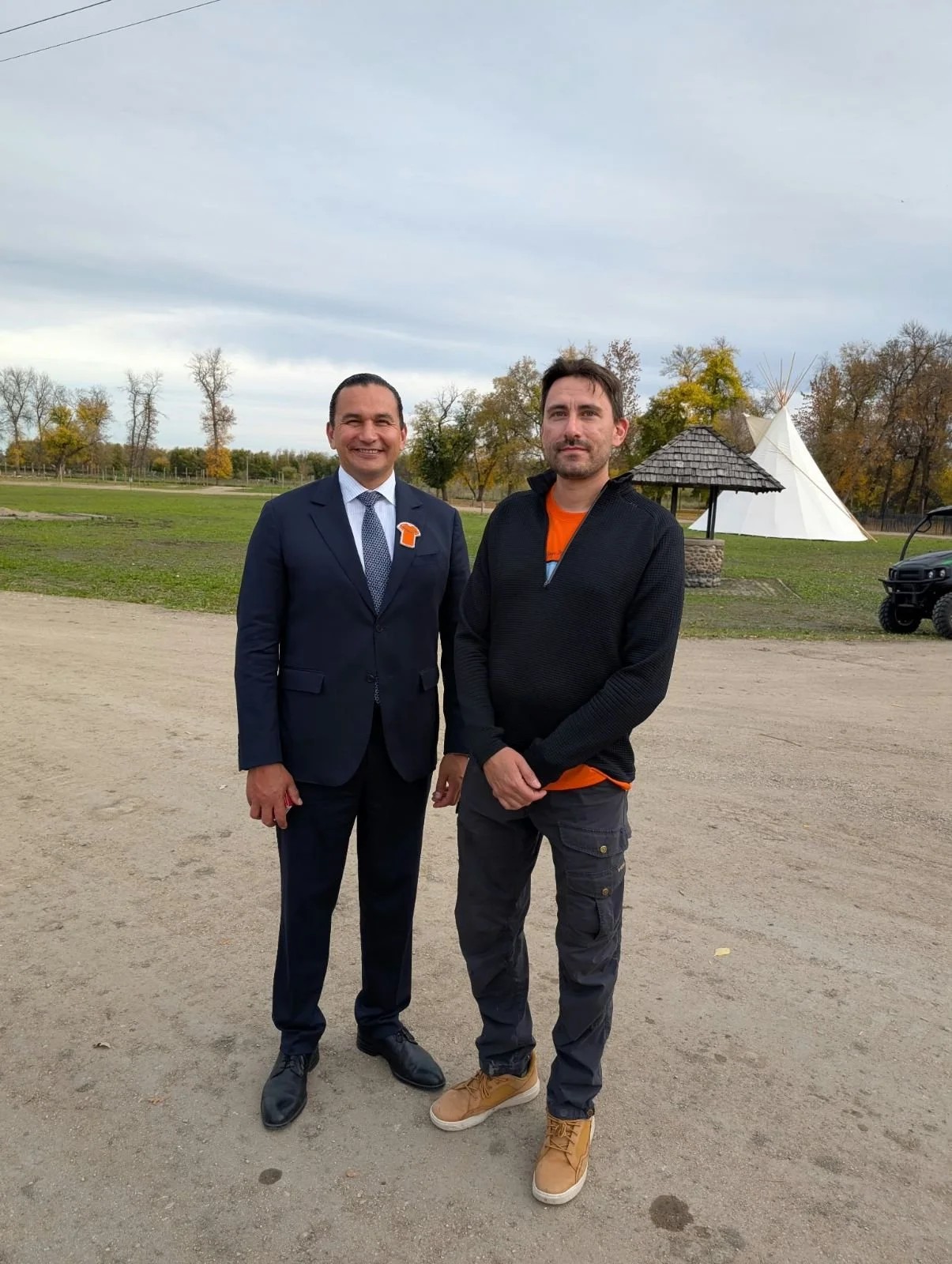
Photo: Premier Wab Kinew and Chris Mancuso, Principal Investigator, at the former Turtle Crossing Campground
On Orange Shirt Day, Premiere Wab Kinew said:
"This Orange Shirt Day we are returning the Brandon Indian Residential School cemetery grounds to the Sioux Valley Dakota Nation on behalf of many First Nations whose children are buried here. This is one of the most well documented burial grounds at a residential school in Canada with not only church and historical records but also contemporaneous newspaper articles describing what happened to these children. You can not deny history."
Archival Work in the CKK
Field investigators depend on the archival record. Attendance logs, death records, and letters between school administrators and officials can identify missing children. They often show a child's identity, time at the school, and the circumstances of death. Two Brandon Residential School Missing Children Investigation (BIRS-MCI) team members carry out this work and enter it into Kwusen's Community KnowledgeKeeper (CKK) database.
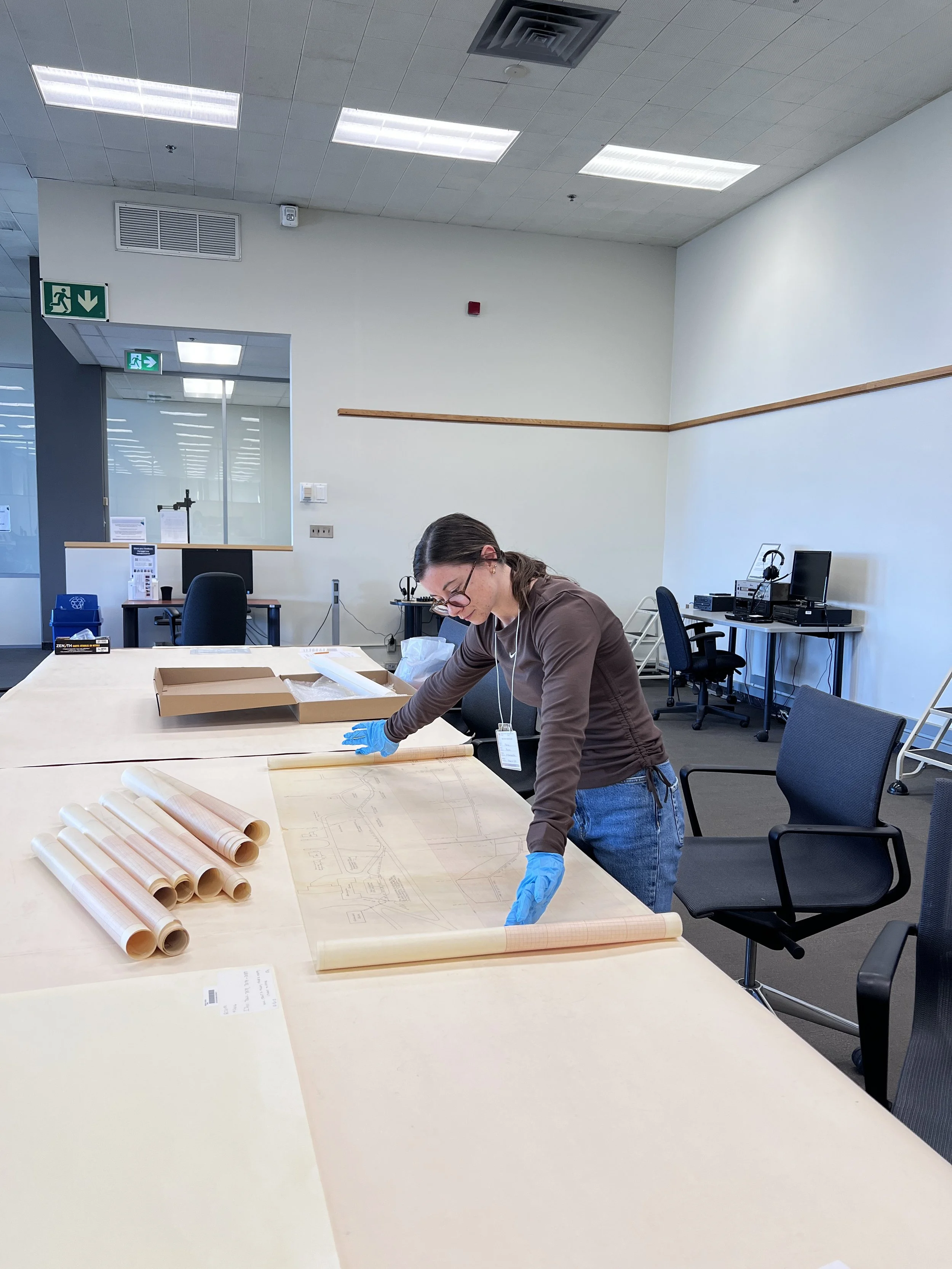
Ashley provides records, field, and archival support for the investigation. As the team's archaeologist, she works in both the archive and the field, and each side of her work informs the other. In the archive, she reviews large-format records such as historical site plans, which show where buildings, roads, and grounds were laid out at different points in the school's history. Plans like these are often rolled, brittle, and hand-drawn, so they have to be opened slowly and held flat to be read and photographed. These records help the field team find where former buildings, pathways, and work areas once stood on the present-day property.
Photo: Ashley Austin, Material Culture and Archival Technician reviewing historical site plan in the Library and Archives Canada Reading Room.
In the field, Ashley compares what the historical plans show with present-day ground conditions. The land around the school has changed through demolition, farming, and later use, so a building shown on a plan map may leave no trace above ground today. Archival records help explain what the field team finds. A historical plan can show what a building was used for, and school records can describe the daily routines that took place there. With this context, objects recovered today can be connected to how children lived and worked at the school. Field findings can also lead back to the archive. They raise new questions about the records and point to documents that still need to be found. Ashley enters this information into the CKK, where archival records and field results can be kept together and linked.
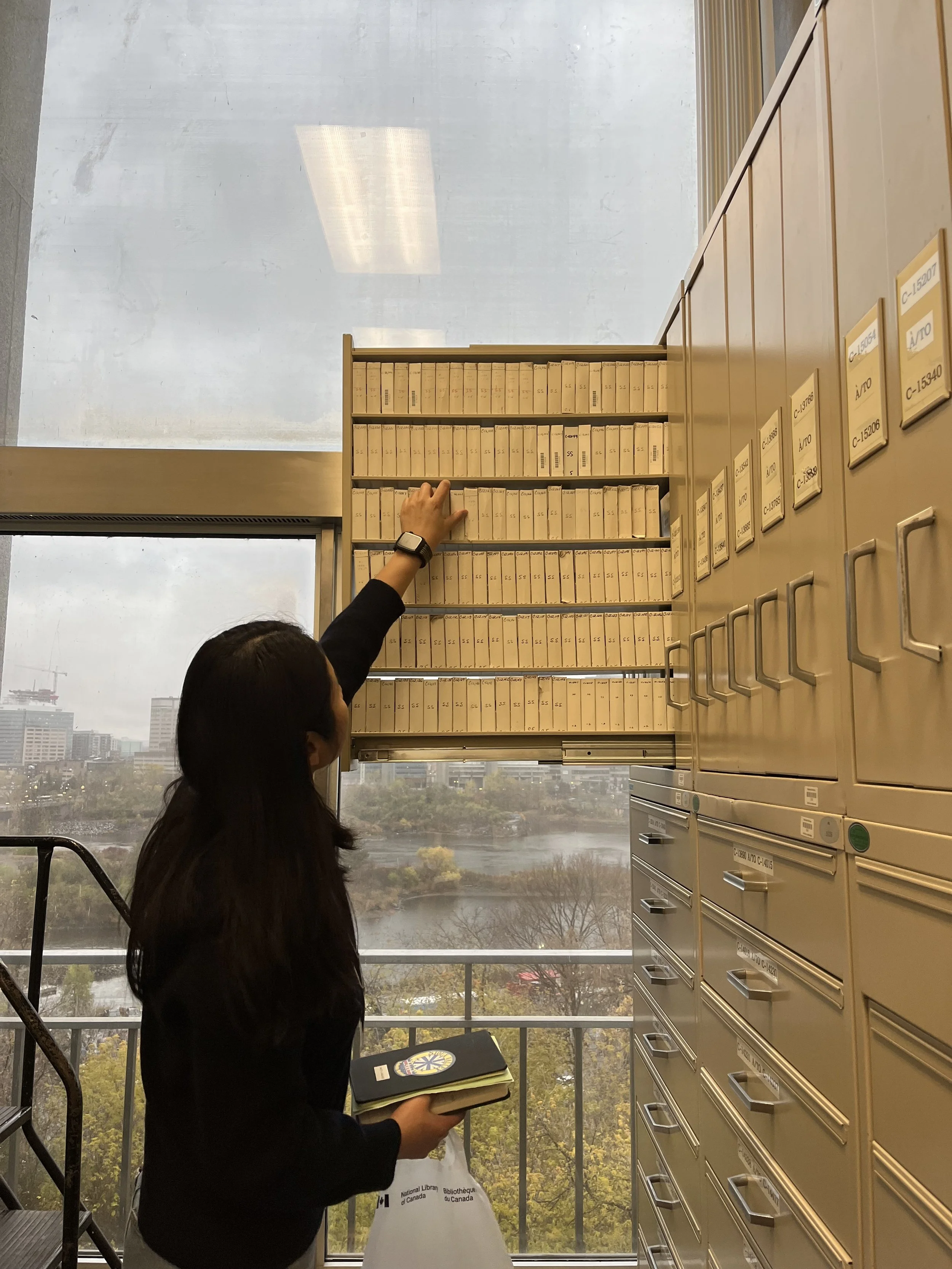
Ling Jin leads records, archives, and names research for the investigation. Records about the school and the children who attended are held by many institutions, so her research takes her to church, provincial, and federal archives across Manitoba and beyond. The churches that ran the school kept their own records, including letters, reports, and administrative files from the Methodist and United Church years. Provincial archives hold records such as vital statistics, land documents, and local newspapers. Federal collections at Library and Archives Canada hold many of the government's school files, and some of those records survive only on microfilm reels.
Photo: Ling Jin, Records Research Coordinator retrieving microfilm at the Library and Archives Canada
At each archive, Ling searches for records about the school and reads through attendance lists, correspondence, and discharge papers. She records each child’s name, home community, and other details as they appear in each document. Many of these records are handwritten, faded, and difficult to read. However, the same child often appears in records held by different institutions, sometimes with a different spelling of their name. Ling compares these records to confirm each child’s identity before the information is entered into the CKK.
Ashley and Ling have uploaded 4,756 archival entries and 2,995 student profiles to the CKK. Each profile records the child’s first and last name, parents’ names, sometimes siblings' names when the information is found through intensive genealogy research, and home community, where they are known. Every profile is linked to the admission, attendance, discharge, and other records where that child’s name appears. A family searching for one child can find all related records in one place. The team also uses the CKK to organize records on building maintenance, school conditions, and staffing. These files show how the school ran day to day and the health and sanitation conditions the children lived with.
From Archives to Commemoration
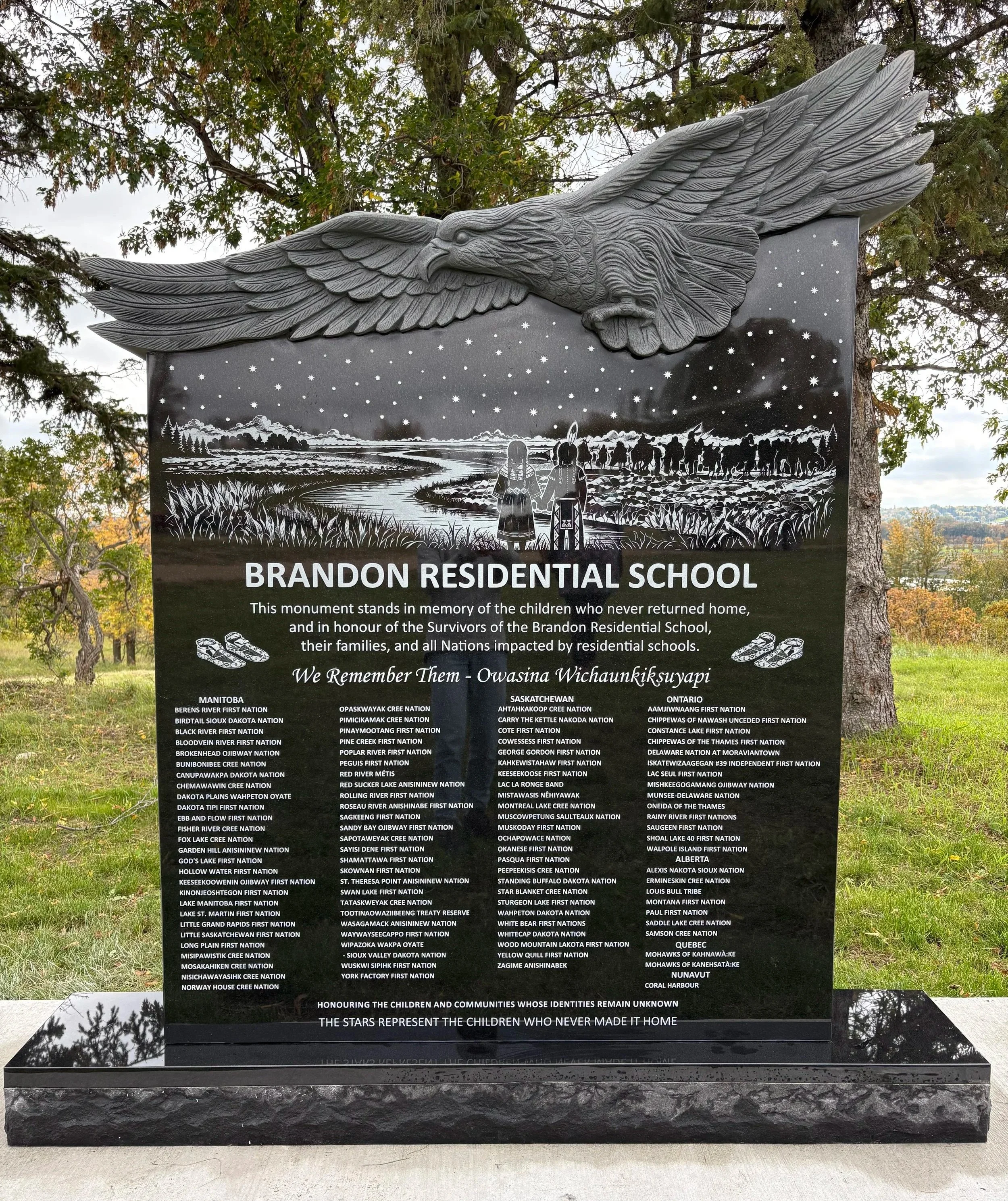
Photo: Brandon Residential School Monument Central Panel
The same records support commemoration. About 2,700 children are now on the Brandon IRS nominal roll, compared with 586 identified before this work began. Each name drawn from the archives is checked against attendance lists, correspondence, and discharge papers, and with information shared directly by families and communities. The central panel above will be joined by eight or more panels with the list of each child’s name who attended the school, so each name must be confirmed before it is included. SVDN is working on engagement sessions with impacted communities and it’s through these sessions as well as community events, including Orange Shirt Day, that give families and Survivors a way to guide this process.
Because the CKK is flexible, Kwusen has been able to work with the SVDN team to adapt features to the investigation's needs. Premier Kinew described the Brandon Residential School cemetery as one of the most well documented burial grounds at a residential school in Canada. That documentation exists because of the work of researchers like Ashley and Ling, who find, read, and preserve the records one at a time. Kwusen will continue to support Sioux Valley Dakota Nation, Ashley, and Ling as this work moves forward.
Written by:
Kate Decter
Research and Development Specialist
Brandon Residential School Missing Children Investigation
Sioux Valley Dakota Nation